

From 2011 to 2016, the demand for titanium materials in China declined, and then showed a sharp upward trend. Since 2008, the demand for titanium materials in China has generally shown an upward trend. In 2011, the market demand for titanium materials reached a staged high point, and then the domestic demand for titanium materials began to decline. China's titanium industry has structural overcapacity, with high-end titanium for aviation in short supply and serious overcapacity of mid-low-end titanium for civil use. Driven by the demand of high-end chemical, aerospace, shipbuilding and electric power industries, the demand for titanium processing materials in China continues to reach new highs.
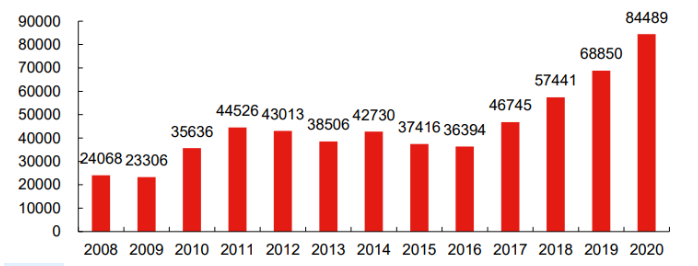
Annual demand for titanium processing materials in China (unit: tons)
1. Batch stability control technology for the quality of titanium alloy materials
The batch stability of titanium alloy material quality directly affects the performance and safety of high-end equipment, and the development of its control technology is an eternal topic. The batch stability of mass production quality is affected by factors such as technological advancement, equipment status, and field operation standardization. With the continuous increase of titanium alloy ingot, ingot and bar specifications, it is necessary to invest heavily in research and development to improve the rationality of the process. The batch stability control technology to improve the quality of titanium alloy materials to meet the requirements of high-end fields.
2. Preparation technology of large titanium alloy ingots, bars and forging billets
In order to improve equipment performance and structural efficiency, reduce structural weight, shorten production cycle and control costs, the amount of titanium alloy parts for new military aircraft, civil large passenger aircraft and various aero-engines are increasingly large, and the proportion of structural integration of titanium alloy parts is getting higher and higher. For example, blades and blisks are replaced by integral blisks, multiple frame beams are replaced by integral frames, and the diameter of the engine case and drum is getting larger and larger. In recent years, many large-scale die forging equipments have been put into operation in China, and the large-tonnage forming technology has developed rapidly. A large number of parts of more new military aircraft and large aircraft in our country have clearly adopted an integrated manufacturing process from the beginning of design. The specifications of titanium alloy bars and forging blanks of related parts are also getting larger and larger, and large titanium alloy ingots. The preparation technology of bar and forging billet is still one of the important directions of industry technology development.
3. Research and development of ultra-high-strength high-toughness titanium alloys and high-temperature titanium alloys
With the increasingly high structural efficiency requirements of new aviation equipment, the demand for ultra-high-strength and high-toughness titanium alloys is becoming more and more urgent. Relevant domestic units have also successively carried out the development of ultra-high-strength titanium alloys above 1,350MPa. Domestically developed ultra-high-strength and high-toughness titanium alloys of 1300MPa+60MPa•m1/2 grades and super-sized forging billets with a single weight of 5 tons and a section thickness of nearly 400 mm, but there is no such large-sized forgings in foreign countries. The technological maturity of ultra-high-strength and high-toughness titanium alloys needs to be further improved. High-temperature titanium alloy is the key material of aero-engines. The operating temperature can cover 300℃~600℃. It can replace some high-temperature alloys and stainless steels and is used to manufacture various engine parts such as blades, discs, casings, drums, etc. of engines and gas turbines.
4. Research and development and preparation technology of special titanium alloys for weapons
Titanium alloy has high specific strength and good corrosion resistance, and has unique advantages in weapons, marine engineering, nuclear power and other fields. For example, the use of titanium alloy as a missile warhead material can not only increase the cruising speed through weight reduction, but also improve the warhead's precise strike capability due to its good damage tolerance. The development of new special titanium alloys is of great significance to its expanded application in high-performance weapons, marine engineering, nuclear power and other fields.